
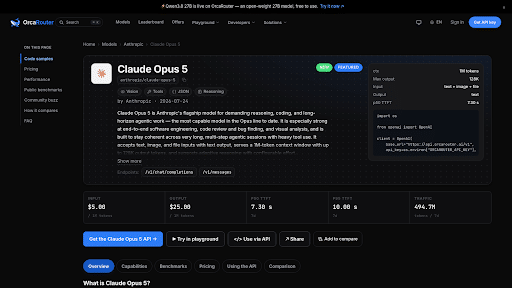
Claude Opus 5 API costs $5 per million input tokens and $25 per million output tokens, with cached input at $0.50 per million. That is the whole rate card — three numbers, no volume tiers, no hidden fees. It is also the least useful piece of pricing information this model offers, because Claude Opus 5 is a reasoning model and reasoning bills as output. The live list pricing is on Claude Opus 5; this article is the plain-language version of what that pricing actually does to real workloads, plus a calculator you can run in your head.
You can price Claude Opus 5 in about thirty seconds: count input tokens, count output tokens, multiply. Almost every cost discussion of this model stops there. The discussion that matters is the one the rate card cannot show — how many output tokens a typical task produces before the model decides it is done. That number is where your bill is decided, and it behaves very differently on a reasoning model than on a chat model.
The rate card, in full
Claude Opus 5 is Anthropic’s flagship reasoning model, released July 24, 2026, with a 1,000,000-token context window per Artificial Analysis’ model page [independent]. The current list pricing, which we verify against our own catalog, is [vendor-reported, verified by OrcaRouter 2026-08-18]:
- Input — $5.00 per million tokens
- Cached input — $0.50 per million tokens (an 80% reduction)
- Output — $25.00 per million tokens
Note the ratio: output is five times the price of input. On a chat model that mostly reflects a prompt back, that ratio barely matters. On a model that can emit thousands of tokens of internal deliberation before every answer, it is the single most important number on the page.
The list price is also the price you pay through us. OrcaRouter passes Anthropic’s rate card through at 0% markup, so the model page for Claude Opus 5 shows exactly these $5 / $25 / $0.50 figures, and a vendor price change reaches you the day it happens rather than the quarter after.
The reasoning-model twist: thinking bills as output
Here is where the calculator gets interesting. Artificial Analysis runs its Intelligence Index — a fixed battery of tasks — against every model it tracks. For Claude Opus 5 at max effort, running that index cost $3,836.05 [independent: Artificial Analysis], and it consumed 100 million output tokens [independent], where the median model in the same price tier burns about 72 million. Per completed task that works out to $2.34 [independent]. On identical published pricing, Claude Opus 5 costs more than the median model for one reason only: it writes more before it answers.
The effort dial makes the same point from a different angle. On the same index, the effort ladder reads max 63.05 → xhigh 62.52 → high 61.48 → medium 58.64 [independent: Artificial Analysis]. The gap between max and medium is about four-and-a-half index points — real, but not the story. The story is that the lower effort levels also cut the thinking tokens, so the per-task cost falls alongside them. If your workload does not need max effort, the cheapest way to shrink the bill is often the effort parameter, not the rate card.
Three worked examples
Let’s put real numbers on it, computed straight from the list rate card [vendor-reported, arithmetic ours]:
| Scenario | Uncached input | Cached input | Output | Estimated bill |
| Light chat (support Q&A, ~2K in / ~300 out) | 2,000 tokens | — | 300 tokens | ~$0.02 |
| Long agentic session (coding agent, tool retries) | 500,000 tokens | 4M tokens | 400,000 tokens | ~$14.50 |
| Cached RAG over a fixed codebase | 200,000 tokens | 6M tokens | 30,000 tokens | ~$4.75 |
Three different workloads, three different lessons. The light chat costs two cents because it barely reasons. The agentic session is the opposite: it spends most of its money on output — $10 of its $14.50 is output tokens, because every tool call, every retry, and every plan is written out before it is acted on. That is the single biggest trap in forecasting this model’s cost: estimate the thinking, not the prompt.
The cached RAG row shows the counterweight. On our own telemetry, Claude Opus 5 served 491.5M tokens over seven days at a p50 time-to-first-token of 7.34 seconds [OrcaRouter, checked 2026-08-22] — a model that thinks before it answers. But when the same large context is cached at $0.50 per million, repeating that context costs a tenth of the uncached input price, and a workload with a stable codebase context moves most of its spend out of the expensive columns entirely.
Why price-per-token is the wrong denominator
If you forecast this model in dollars per million tokens, you will be wrong in a predictable direction: your actual bill will land above your estimate, because output is five times input and reasoning models are output-heavy. That is why the useful denominator for a reasoning model is price per completed task, measured on your workload, not a generic token price.
To see why, compare cost-per-task across models the way Artificial Analysis does: on the same index, Claude Opus 5 at max effort costs $2.34 per task [independent], while a leading alternative we track runs about $1.23 per task [independent] — but that alternative is being compared at its own max effort configuration. Comparing a max-effort reasoning model against a non-reasoning model at default effort is apples-to-oranges; the honest comparison always names the configuration on both sides [our analysis].
Practical ways to keep the number down:
- Use the cache. At $0.50 per million against $5.00, cached input is an 80% saving, and any workload with stable system context is a candidate.
- Dial effort to what the task needs. The ladder from medium to max is roughly four-and-a-half index points on the same battery [independent], but the token cost between them is far larger than the quality gap on most routine calls.
- Budget in tasks, not tokens. Measure a representative sample of your real workload, compute cost per completed task, and scale from that. Token-based forecasts will quietly undercount thinking.
- Don’t pay a markup on a rate card. The vendor’s list price is the list price. A platform that passes it through at 0% markup — as OrcaRouter does, with one key covering 200+ models — means the price you plan against is the price you pay.
The takeaway
Claude Opus 5’s rate card is trivial to state and easy to misuse: $5 in, $25 out, $0.50 cached. The cost calculator that actually predicts your bill has one more input — how long the model thinks before answering — and that input dominates everything else. It suits teams whose tasks reward deep deliberation: long-horizon agentic work, hard code, open-ended analysis, where output tokens buy correctness. It is overkill for simple extraction or classification, where you are paying $25-per-million tokens for thinking you never use. Price it per completed task on your own workload, tune the effort dial, lean on the cache — and buy it through a channel that passes the list price through unchanged, so the number you signed up for is the number you get.
Sourcing note: rate card figures ($5 / $25 / $0.50 and the 80% cache reduction) are Anthropic’s published list prices, re-verified against OrcaRouter’s catalog on August 18, 2026. Intelligence Index scores, cost per task, total evaluation cost and output-token counts are from Artificial Analysis’ live model page, checked August 22, 2026. OrcaRouter traffic and latency figures are OrcaRouter’s own telemetry for the seven days ending August 22, 2026. Vendor pricing changes without notice.